Issue 59 Folklore (digital only)
July/August 2014


Please note this issue is only available digitally
I RECENTLY HAD LUNCH WITH with Gudrun Sjödén during the preview of her retrospective exhibition Gudrun Sjödén: 40 years in Fashion, at the Kulturen museum, in the South of Sweden. After we had eaten the curator suggested we look at the goodies – it wasn’t figurative painting or sculpture she had in mind but the folk art embroidery. These gems, produced by ordinary people with no formal art training, had a Joie de vivre that is often harder to find in traditional “high art”. The brightly coloured, sometimes crude, sometimes sophisticated, pieces seem to have a depth of meaning that “fine artists” can struggle to communicate. In contrast folk art effortlessly demonstrates the hand of an individual maker, as well as the history of an entire culture.
This summer’s exhibition at Tate Britain is British Folk Art, Curator Martin Myrone discusses the highlights and hopes the show will bring this genre to greater public attention. Another curator, James Russell, thinks he became infected with the folk art bug after visiting the Museum of International Folk Art in Santa Fe. James is the author of Peggy Angus: Designer, Teacher, Painter, the subject of an exhibition at the Towner Gallery in Eastbourne. Many of Angus’s contemporaries working in textiles in the mid 20th century, including Phyllis Barron, Dorothy Larcher and Enid Marx came to the fore using block printing. Design historian Lesley Jackson traces the genealogy of this process and finds that, although the appeal of folk art is still strong, economic necessity is driving makers towards different means to communicate their ideas.
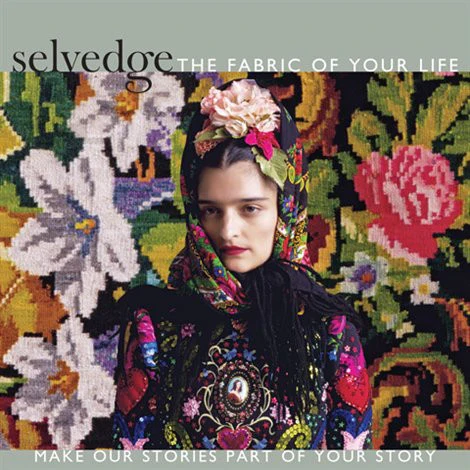
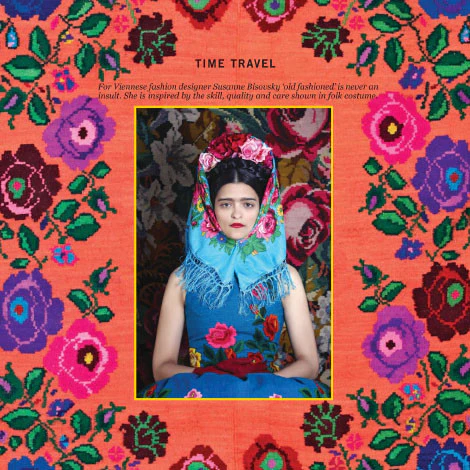
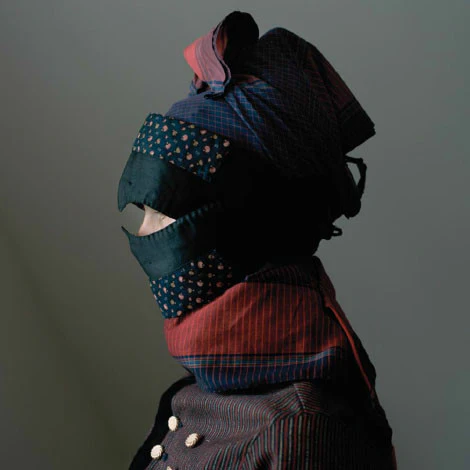
If we examine art history an interest in folk culture is a recurring theme. In Denmark photographer Trine Søndergaard, has captured the iconography of folk culture in her arresting series of images Strude. The artist Frida Kahlo was fascinated by the folk culture of her native Mexico. For a closer look at this vibrant culture read Hilary Simon’s whistle stop tour of Mexican textiles or visit the exhibition at London’s Fashion and Textile Museum Made in Mexico, The Rebozo in Art, Culture & Fashion. Images of Frida wearing traditional costume has enthralled many, including Susanne Bisovsky, a Viennese fashion designer who puts her own Austrian twist on the familiar image and whose photograph of Alexandra Liedtke graces our cover. This mix of cultures, histories and styles updates folk art for a contemporary audience. In the Selvedge office we are lusting after Stella Jean’s collection, which blends 1950s inspired fashions with references to her Haitian roots and demonstrates how fantastic fusions can be...
Polly Leonard, Founder
More Images

Issue 59 Folklore (digital only)
July/August 2014
Please note this issue is only available digitally
I RECENTLY HAD LUNCH WITH with Gudrun Sjödén during the preview of her retrospective exhibition Gudrun Sjödén: 40 years in Fashion, at the Kulturen museum, in the South of Sweden. After we had eaten the curator suggested we look at the goodies – it wasn’t figurative painting or sculpture she had in mind but the folk art embroidery. These gems, produced by ordinary people with no formal art training, had a Joie de vivre that is often harder to find in traditional “high art”. The brightly coloured, sometimes crude, sometimes sophisticated, pieces seem to have a depth of meaning that “fine artists” can struggle to communicate. In contrast folk art effortlessly demonstrates the hand of an individual maker, as well as the history of an entire culture.
This summer’s exhibition at Tate Britain is British Folk Art, Curator Martin Myrone discusses the highlights and hopes the show will bring this genre to greater public attention. Another curator, James Russell, thinks he became infected with the folk art bug after visiting the Museum of International Folk Art in Santa Fe. James is the author of Peggy Angus: Designer, Teacher, Painter, the subject of an exhibition at the Towner Gallery in Eastbourne. Many of Angus’s contemporaries working in textiles in the mid 20th century, including Phyllis Barron, Dorothy Larcher and Enid Marx came to the fore using block printing. Design historian Lesley Jackson traces the genealogy of this process and finds that, although the appeal of folk art is still strong, economic necessity is driving makers towards different means to communicate their ideas.
If we examine art history an interest in folk culture is a recurring theme. In Denmark photographer Trine Søndergaard, has captured the iconography of folk culture in her arresting series of images Strude. The artist Frida Kahlo was fascinated by the folk culture of her native Mexico. For a closer look at this vibrant culture read Hilary Simon’s whistle stop tour of Mexican textiles or visit the exhibition at London’s Fashion and Textile Museum Made in Mexico, The Rebozo in Art, Culture & Fashion. Images of Frida wearing traditional costume has enthralled many, including Susanne Bisovsky, a Viennese fashion designer who puts her own Austrian twist on the familiar image and whose photograph of Alexandra Liedtke graces our cover. This mix of cultures, histories and styles updates folk art for a contemporary audience. In the Selvedge office we are lusting after Stella Jean’s collection, which blends 1950s inspired fashions with references to her Haitian roots and demonstrates how fantastic fusions can be...
Polly Leonard, Founder
Product Information
Product Information
Shipping & Returns
Shipping & Returns
Description
July/August 2014
Please note this issue is only available digitally
I RECENTLY HAD LUNCH WITH with Gudrun Sjödén during the preview of her retrospective exhibition Gudrun Sjödén: 40 years in Fashion, at the Kulturen museum, in the South of Sweden. After we had eaten the curator suggested we look at the goodies – it wasn’t figurative painting or sculpture she had in mind but the folk art embroidery. These gems, produced by ordinary people with no formal art training, had a Joie de vivre that is often harder to find in traditional “high art”. The brightly coloured, sometimes crude, sometimes sophisticated, pieces seem to have a depth of meaning that “fine artists” can struggle to communicate. In contrast folk art effortlessly demonstrates the hand of an individual maker, as well as the history of an entire culture.
This summer’s exhibition at Tate Britain is British Folk Art, Curator Martin Myrone discusses the highlights and hopes the show will bring this genre to greater public attention. Another curator, James Russell, thinks he became infected with the folk art bug after visiting the Museum of International Folk Art in Santa Fe. James is the author of Peggy Angus: Designer, Teacher, Painter, the subject of an exhibition at the Towner Gallery in Eastbourne. Many of Angus’s contemporaries working in textiles in the mid 20th century, including Phyllis Barron, Dorothy Larcher and Enid Marx came to the fore using block printing. Design historian Lesley Jackson traces the genealogy of this process and finds that, although the appeal of folk art is still strong, economic necessity is driving makers towards different means to communicate their ideas.
If we examine art history an interest in folk culture is a recurring theme. In Denmark photographer Trine Søndergaard, has captured the iconography of folk culture in her arresting series of images Strude. The artist Frida Kahlo was fascinated by the folk culture of her native Mexico. For a closer look at this vibrant culture read Hilary Simon’s whistle stop tour of Mexican textiles or visit the exhibition at London’s Fashion and Textile Museum Made in Mexico, The Rebozo in Art, Culture & Fashion. Images of Frida wearing traditional costume has enthralled many, including Susanne Bisovsky, a Viennese fashion designer who puts her own Austrian twist on the familiar image and whose photograph of Alexandra Liedtke graces our cover. This mix of cultures, histories and styles updates folk art for a contemporary audience. In the Selvedge office we are lusting after Stella Jean’s collection, which blends 1950s inspired fashions with references to her Haitian roots and demonstrates how fantastic fusions can be...
Polly Leonard, Founder