Issue 105 Checks & Stripes

March / April 2022
Published 15 February, 2022
CHECKS & STRIPES The Geometry of Cloth I was far too cool to admit to enjoying maths at high school, I loved its beauty and the magic of geometry. Perhaps this is something all textile enthusiasts have in common–whether you create surface patterns like Cressida Bell, construct garments like Yeolee Teng, weave sculptures like Kazuhito Takadoi or make quilts like Jenni Smith. Geometry and mathematics are fundamental to all textile making. Remember the first computer had its origins in the Jacquard Loom invented in 1804!
While the symmetry and structure of an Amish Quilt is visually satisfying, for me it is when the geometry is challenged and the structure disruped by the force of nature, whether this is the will of the material as seen in Ruth Castle’s beautiful modernist baskets or the evidence of the hand of the maker in the godharis quilts of Maharashtra, India. This tension and visual interest are evident in my favourite handmade textiles throughout the world, some of which we feature in this issue.
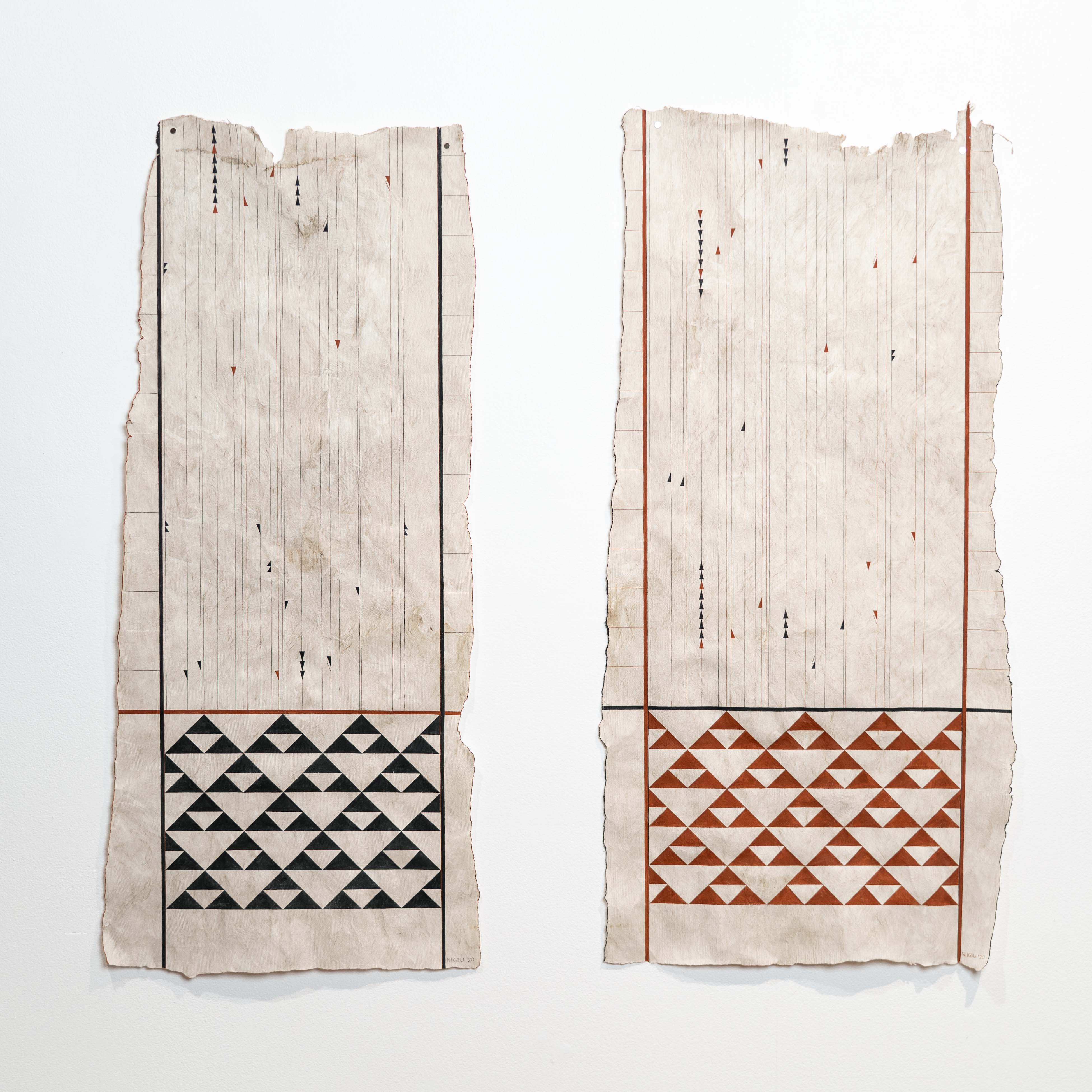
Māori artist Nikau Hindin–Ngai Tpoto hp, Te Rarawa, Ngpuhi–from Aotearoa, or New Zealand, paints geometric interpretations of star maps with earth pigments onto aute that she beats herself from the bark of the wauke tree, connecting her textile making to botany, astronomy, chemistry and Indigenous knowledge systems. Within the British education system, students are pushed to choose between the arts and sciences at an early age. Were textiles a more important part of the curriculum, educators could use their seductive power as a hook to engage students in the numerous branches of science that intersect textile making.
Carefull not to neglect the arts: I would like to take this opportunity to invite you to join us for our first Textile Literary Festival on Saturday 2 April. To find out more visit www.selvedge.org.
Polly Leonard, Founder & Editor of Selvedge Magazine
Original: $33.61
-65%$33.61
$11.76More Images






Issue 105 Checks & Stripes
March / April 2022
Published 15 February, 2022
CHECKS & STRIPES The Geometry of Cloth I was far too cool to admit to enjoying maths at high school, I loved its beauty and the magic of geometry. Perhaps this is something all textile enthusiasts have in common–whether you create surface patterns like Cressida Bell, construct garments like Yeolee Teng, weave sculptures like Kazuhito Takadoi or make quilts like Jenni Smith. Geometry and mathematics are fundamental to all textile making. Remember the first computer had its origins in the Jacquard Loom invented in 1804!
While the symmetry and structure of an Amish Quilt is visually satisfying, for me it is when the geometry is challenged and the structure disruped by the force of nature, whether this is the will of the material as seen in Ruth Castle’s beautiful modernist baskets or the evidence of the hand of the maker in the godharis quilts of Maharashtra, India. This tension and visual interest are evident in my favourite handmade textiles throughout the world, some of which we feature in this issue.
Māori artist Nikau Hindin–Ngai Tpoto hp, Te Rarawa, Ngpuhi–from Aotearoa, or New Zealand, paints geometric interpretations of star maps with earth pigments onto aute that she beats herself from the bark of the wauke tree, connecting her textile making to botany, astronomy, chemistry and Indigenous knowledge systems. Within the British education system, students are pushed to choose between the arts and sciences at an early age. Were textiles a more important part of the curriculum, educators could use their seductive power as a hook to engage students in the numerous branches of science that intersect textile making.
Carefull not to neglect the arts: I would like to take this opportunity to invite you to join us for our first Textile Literary Festival on Saturday 2 April. To find out more visit www.selvedge.org.
Polly Leonard, Founder & Editor of Selvedge Magazine
Product Information
Product Information
Shipping & Returns
Shipping & Returns
Description
March / April 2022
Published 15 February, 2022
CHECKS & STRIPES The Geometry of Cloth I was far too cool to admit to enjoying maths at high school, I loved its beauty and the magic of geometry. Perhaps this is something all textile enthusiasts have in common–whether you create surface patterns like Cressida Bell, construct garments like Yeolee Teng, weave sculptures like Kazuhito Takadoi or make quilts like Jenni Smith. Geometry and mathematics are fundamental to all textile making. Remember the first computer had its origins in the Jacquard Loom invented in 1804!
While the symmetry and structure of an Amish Quilt is visually satisfying, for me it is when the geometry is challenged and the structure disruped by the force of nature, whether this is the will of the material as seen in Ruth Castle’s beautiful modernist baskets or the evidence of the hand of the maker in the godharis quilts of Maharashtra, India. This tension and visual interest are evident in my favourite handmade textiles throughout the world, some of which we feature in this issue.
Māori artist Nikau Hindin–Ngai Tpoto hp, Te Rarawa, Ngpuhi–from Aotearoa, or New Zealand, paints geometric interpretations of star maps with earth pigments onto aute that she beats herself from the bark of the wauke tree, connecting her textile making to botany, astronomy, chemistry and Indigenous knowledge systems. Within the British education system, students are pushed to choose between the arts and sciences at an early age. Were textiles a more important part of the curriculum, educators could use their seductive power as a hook to engage students in the numerous branches of science that intersect textile making.
Carefull not to neglect the arts: I would like to take this opportunity to invite you to join us for our first Textile Literary Festival on Saturday 2 April. To find out more visit www.selvedge.org.
Polly Leonard, Founder & Editor of Selvedge Magazine